

17 ACRES OF KITEEZI LANDFILL REHABILITATED IN FIRST PHASE
PUBLISHED — 5th, August 2026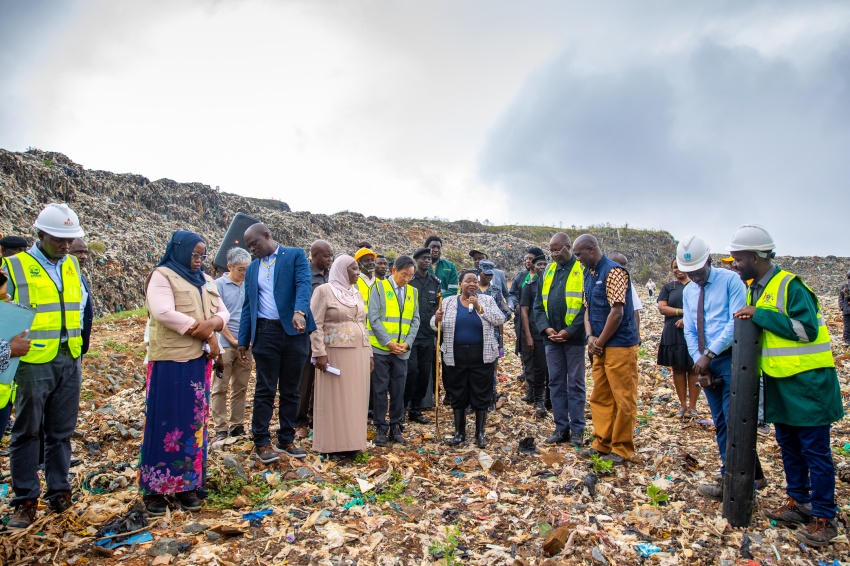
A total of 16.8 acres of the Kiteezi landfill have been rehabilitated and handed over to Kampala Capital City Authority (KCCA) following the completion of the first phase of an emergency effort to stabilise the waste disposal site.
The handover of the rehabilitated sections and closure of the year-long “Emergency Technical Assistance to Rehabilitate Kiteezi Landfill” project was marked Wednesday at the site in an event attended by Uganda’s Prime Minister Robinah Nabbanja, government officials, representatives from the Government of Japan, UN-Habitat and KCCA.
The rehabilitation, funded through a $1 million grant from the Government of Japan and implemented in partnership with UN-Habitat, focused on securing high-risk sections of the landfill rather than completing rehabilitation of the entire facility.
The Kiteezi landfill, which covers about 36 acres, still requires additional work, with officials saying about 20 acres remain to be rehabilitated.
The intervention was launched after the partial collapse of the landfill in August 2024, which forced authorities to accelerate measures to stabilise the waste mass and protect communities living near the site.
Speaking at the handover ceremony, Nabbanja described the rehabilitation as a sign of what can be achieved through international cooperation and improved planning.
She thanked the Government of Japan for supporting the intervention and commended UN-Habitat for implementing the project.
“When you look at how it was in 2024 and how it looks now, you have done a great job,” Nabbanja said.
The prime minister said Uganda should now look beyond managing waste and focus on turning it into an economic opportunity through recycling, recovery and investment.
The rehabilitation works applied the Fukuoka Method, a Japanese-engineered landfill management approach that improves the stability of old dumpsites while reducing methane emissions.
The method involves creating safer landfill conditions through improved drainage, ventilation and controlled decomposition of waste.
Engineers working on the project reshaped unstable waste slopes, cut down steep waste cliffs, constructed terraces on high-risk sections and strengthened the garbage mass to reduce the possibility of further collapse.
A network of gas ventilation pipes was installed to manage methane produced by decomposing waste, while leachate collection systems and treatment facilities were developed to control contaminated water generated within the landfill.
The project also included training for KCCA technical staff in landfill risk management to support long-term monitoring and maintenance of the rehabilitated sections.
Japanese Ambassador to Uganda Sasayama Takuya said the rehabilitation of Kiteezi demonstrated the importance of adopting broader solutions to address the growing challenge of urban waste management. He commended Prime Minister for championing the National Clean Days initiative, noting that keeping cities clean requires more than just waste collection and transportation.
Government calls for more support
Officials at the ceremony stressed that while the completed works represent significant progress, rehabilitation of Kiteezi landfill is far from complete.
Minister for Kampala Capital City and Metropolitan Affairs Hajjat Minsa Kabanda described the intervention as the realisation of a long-standing goal.
“It was a dream to rehabilitate this, and the dream has come true,” she said, thanking the Japanese government and UN-Habitat for their support.
However, she called for continued assistance to address the remaining sections of the landfill.
“We have worked on 16 acres, but 20 more need to be rehabilitated,” she said.
State Minister for Kampala Capital City and Metropolitan Affairs Kabuye Kyofatogabye said additional funding would be required to complete the remaining rehabilitation works.
“The work is not yet over. Out of 36 acres, we have so far done 16.8 and have 20 acres to finish,” he said.
He estimated that at least $2 million would be needed to continue the next phase of rehabilitation.
KCCA Executive Director Sharifah Buzeki say the rehabilitation is part of wider efforts to modernise waste management in Kampala, including promoting recycling, waste recovery and private sector participation.
The project’s completion marks a significant step in securing parts of the landfill, but officials acknowledge that further investment will be needed to fully address the remaining risks and transition Kampala towards a more sustainable waste management future.
By Geofrey Mutegeki Araali
Communication and Media Relations Officer
News & Announcements
5th, August 2026
3rd, August 2026
30th, July 2026
25th, July 2026
17th, July 2026
15th, July 2026
14th, July 2026
11th, July 2026
10th, July 2026
10th, July 2026








Development partners